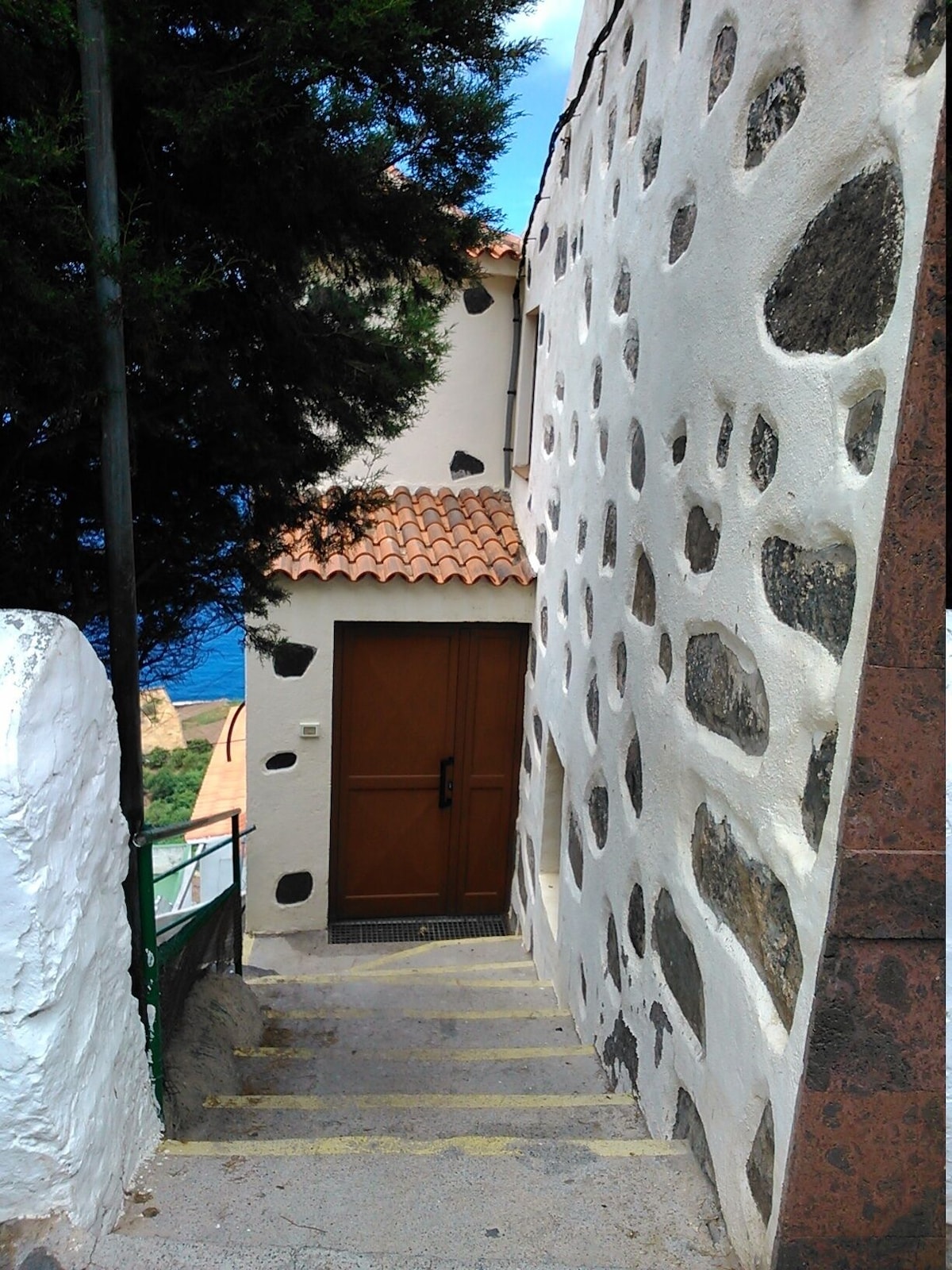
The town of Agulo, known by locals as the “green balcony,” consists of two parts and is the smallest of the six municipalities on the Canary Island of La Gomera.
Agulo is picturesquely situated between fertile green terraced fields and rugged, nearly vertical cliffs (“red wall”) between Vallehermoso and Hermigua.
In the lower-lying region lies Agulo Casco, surrounded by a natural amphitheatre that encompasses the three hamlets of La Montañeta, Las Casas, and El Charco, as well as the somewhat secluded farmstead Caserio de Lepe.
Above lies the town centre of Agulo at an elevation of about 250 metres; it was founded in the 1620s.
A stroll through the narrow, winding alleys takes you past old colonial buildings to the beautiful village church “Iglesia de San Marcos,” built around 1920 in the Moorish style. There, old trees invite you to rest and linger. The church houses a remarkable statue of Christ by the Canarian artist Pérez Donis.
Agulo’s compact layout is unique
and that is why the village is considered “the pearl of Gomera.”
The higher-altitude area of Sobreagulo, with the hamlets of Las Rosas, La Palmita, Meriga (the Meriga Forest has been designated an UNESCO World Heritage Site), and Cruz de Tierno, lies near Garajonay National Park.
The small local population continues to produce the island’s traditional handicrafts and makes its living primarily from fishing and agriculture, with bananas still being the number one crop.
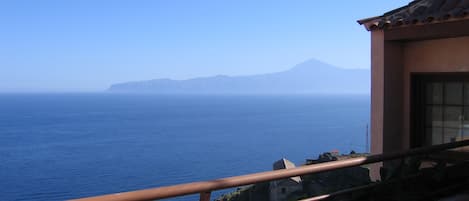
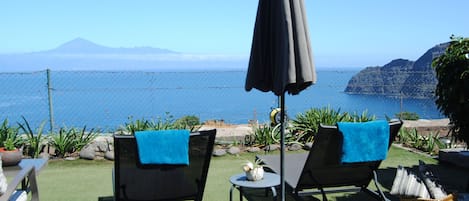
The Abrante viewpoint offers a spectacular view of the Agulo basin with the island of Tenerife in the background.