Experience the true essence of Salerno in the historic heart of the city, dating back to 197 B.C.
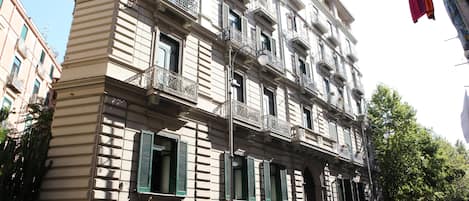
The apartment exudes the charm of its building’s history: an 18th-century noble palace where the writer Davide Galdi was born, formerly a retirement home for the Little Working Sisters of the Sacred Hearts, and now protected by the Salerno Superintendence of Cultural Heritage.
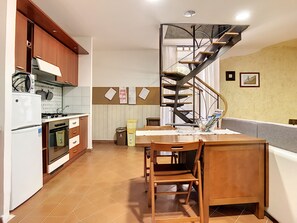
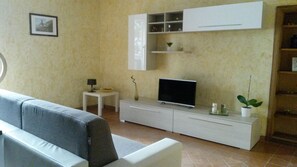
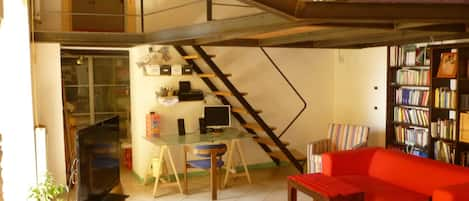
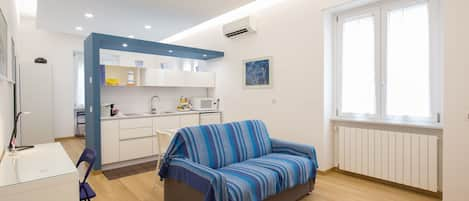
The home is very cosy and consists of a spacious living area with a sofa bed, a kitchenette, a bathroom, a bedroom, and a walk-in closet with a hydromassage shower. The apartment is equipped with every comfort: a curved smart TV, microwave, electric kettle, ironing board and iron, hair dryer, etc. You’ll enjoy your holiday with complete freedom and independence. During your stay, you’ll appreciate the central location and the warm, welcoming atmosphere. It’s the ideal accommodation for a romantic and relaxing getaway, without missing out on the fun and opportunities the city centre has to offer.
Located at the start of the Historic Center’s pedestrian zone and just steps away from all the main tourist and cultural attractions, it’s perfect for your leisure time, offering the chance to stroll through the characteristic narrow alleys—once walked by the Romans, then by the Lombards, and later by the Normans, in an authentic atmosphere of times long past.
Its enviable and strategic location allows you to fully enjoy the vibrant nightlife of Salerno, with restaurants, pizzerias, bars, and pubs where the fun lasts well into the night—yet you’ll have the privilege of resting in complete peace and relaxation, shielded from any disturbing noise.
The building is located at the entrance to the restricted traffic zone (ZTL), right next to the Cathedral—with its extraordinary crypt housing the relics of Saint Matthew, one of Christ’s twelve apostles—and the Diocesan Museum, which boasts a rich collection of ancient illuminated manuscripts. It is just a short walk from the monumental complex of Saint Sophia (150 m), the Temple of Pomona (180 m), Palazzo Fruscione (270 m), the Church of St. Peter in Corte (300 m) and the Roman-era thermal baths below it, the Provincial Archaeological Museum (350 m), and the Provincial Art Gallery (300 m). As you stroll through the charming alleys of the historic village, teeming with artisan shops, restaurants, and trattorias offering tastings of local products and traditional dishes, you’ll admire historic buildings where, throughout the year, exhibitions of significant artistic and cultural interest are regularly held, along with events such as “Comicon”, “Linea d’Ombra,” “Trekking Urbano,” and “Salerno Letteratura.” In just a few minutes, you’ll reach the 19th-century Verdi Theatre (800 m), the Minerva Gardens (the historic botanical garden of the Salerno Medical School) (500 m), the Medieval Aqueduct (500 m), the Martucci Conservatory (600 m), the shopping street Via dei Mercanti (230 m), the waterfront (400 m), San Teresa Beach (650 m), the oyster-shaped maritime station designed by Zaha Hadid (1.2 km), the Villa Comunale (650 m), and Pinocchio Park (1.6 km), where your children can play in peace; as well as the Museo dello Sbarco, “Salerno Capitale 1943,” and all other sites of historical and cultural interest; meanwhile, Arechi Castle—an imposing 6th-century fortress and symbol of Salerno’s history—overlooks the city from above. During the “Luci d’Artista” festival, the historic centre is transformed into an “enchanted garden.”
Furthermore, the house’s ideal location makes it an excellent base for exploring the region’s attractions. Public transport for your excursions to Campania’s most famous sites is easily accessible on foot: the exceptional natural attractions (Amalfi Coast, Island of Capri, Vesuvius National Park, the Cilento Coast, and the Cilento and Vallo di Diano National Park) as well as historical sites (the archaeological excavations at Pompeii (30 km) and Paestum (40 km)) are all close to the city.
Since the apartment is located between the old and new parts of the city, it has excellent access to amenities: small traditional shops and supermarkets, restaurants, bars, pharmacies, banks, and a post office; metro station (220 m) at Duomo/Via Vernieri, which connects to Pompeii to the north and Paestum to the south; train station (1.5 km); city and intercity bus stops; and the port (1 km).
It is located at the entrance to the restricted-traffic zone; therefore, the closest point accessible by car