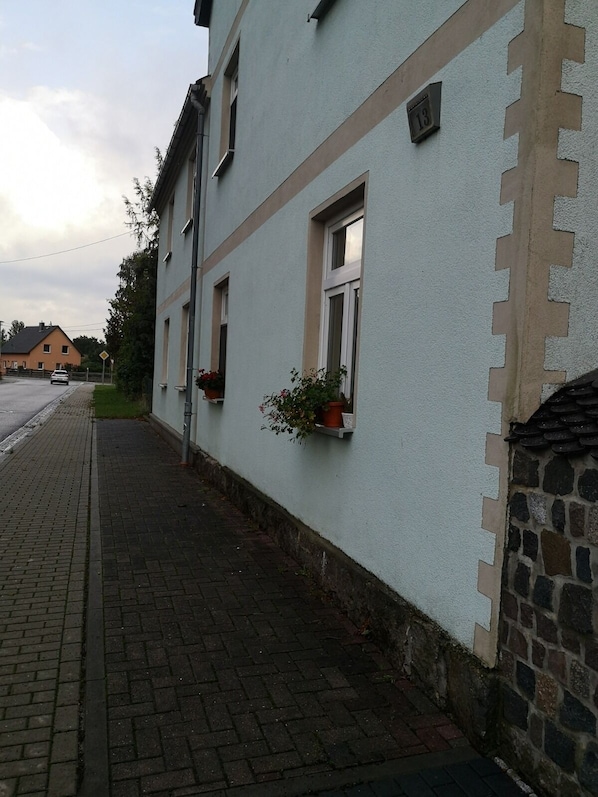
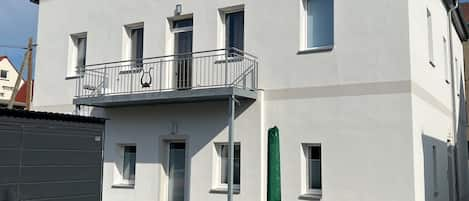
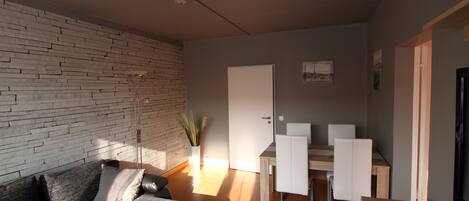
Access to the highway towards Halle, Dresden, and Göttingen, as well as an S-Bahn connection to Leipzig; across from the holiday rental is a horse farm
Kirchbruch Beucha
Kirchbruch Beucha, Photo: Anja Hartmann
Geotope type: Abandoned quarry
Rock: Beucha granite porphyry
Geological period: Permian (Rotliegend)
Beucha granite porphyry—a microsyenogranite based on its rock composition—is best known as the building stone used in the construction of the Monument to the Battle of the Nations in Leipzig. The monument was dedicated in 1913 to mark the centennial of the decisive battle in the War of Liberation against Napoleonic France. However, Beucha granite porphyry had already been used as a building material (stone) since the 15th century. In the 19th century, quarrying was intensified through industrial methods. In addition to the Kirchbruch quarry, numerous other quarries sprang up in and around Beucha, such as the Tollertbruch, the “Sorge” quarry, and the Hausbruch. In Leipzig, for example, the granite porphyry was used in the Central Station, the German National Library, and the Old Town Hall. The history of the quarrying operations can be explored on the “7 Quarries Hiking Trail” between Brandis and Beucha.
The rock of the Kirchberg, which today stands about 80 metres high, formed some 290 million years ago. During the Ice Age, 350 000 years ago, it was “smoothed down” into a rounded hill. Later, the quarries “gnawed” away at it. Due to intensive quarrying in the area of the Kirchbruch, the Beucha Mountain Church—a Romanesque church with a choir tower—gained its prominent location on the mountain spur. The quarry was shut down in the late 1950s. Today, the Kirchbruch is filled with water and is used for local recreation.
In September 2019, the Kirchbruch Beucha was awarded the designation “National Geotope” by the Academy of Geosciences and Geotechnologies e.V.
At the same time, the climbing forest at Autobahnsee attracts visitors